
By Dr. Anil Siddharth Tambe
Pediatric Gastroenterologist & Hepatologist | Mumbai
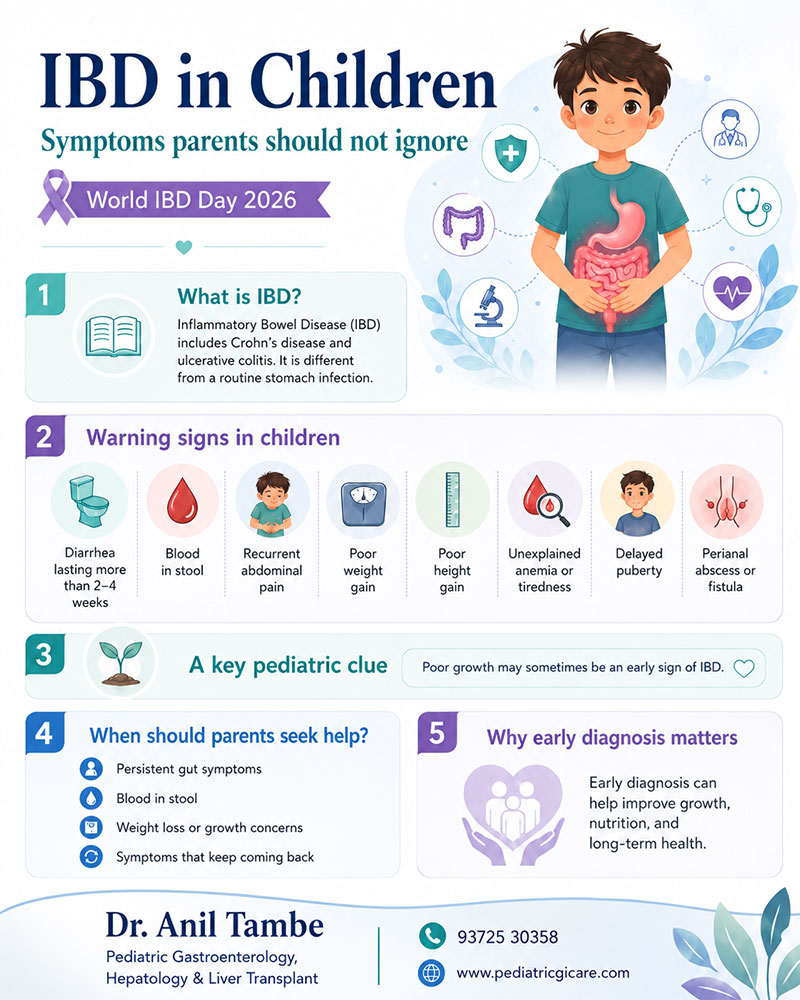
Every year, World IBD Day is observed on 19 May to raise awareness about inflammatory bowel disease (IBD).
Many parents think of IBD as an adult condition. But children and teenagers can also develop IBD, and pediatric IBD is being diagnosed more frequently across the world—including in India.
The message this World IBD Day is simple:
👉 Early diagnosis can change outcomes.
When IBD is detected early, children can receive the right treatment, improve their nutrition, grow better, and avoid long-term complications.
IBD stands for Inflammatory Bowel Disease, a chronic condition where there is ongoing inflammation in the digestive tract.
The two main types are:
IBD is different from routine stomach infection, food intolerance, or irritable bowel syndrome. It requires proper diagnosis and long-term care.
Yes—children can develop IBD.
Children with IBD may not always present like adults. Some children have obvious symptoms such as diarrhea or blood in stool. But others may present with more subtle signs, such as poor growth, anemia, tiredness, poor appetite, or delayed puberty.
This is why IBD can sometimes be missed in the early stages.
Medical literature shows that early recognition is important because diagnostic delay can increase the risk of complications, including growth impairment. Pediatric IBD can also affect nutrition, puberty, bone health, school attendance, and emotional well-being.
Parents should seek medical advice if a child has any of the following symptoms, especially if they are persistent or keep coming back:
Warning sign
Why it matters
👉 One important point: IBD in children may not always begin with diarrhea.
Growth is one of the strongest indicators of a child’s overall health.
In children with IBD, ongoing inflammation can affect appetite, absorption of nutrients, energy levels, and growth hormones. A child may gradually stop gaining weight or height at the expected rate.
Parents should be alert if:
IBD cannot be diagnosed only by symptoms. A proper evaluation is needed.
Fecal calprotectin is a useful non-invasive stool test. It helps doctors decide whether symptoms may be due to intestinal inflammation. However, it must be interpreted carefully. A high value does not always mean IBD, and a normal value does not always replace clinical judgment. Red flag symptoms should not be ignored.
If IBD is suspected, the child may need specialist evaluation, endoscopy, colonoscopy with biopsies, and imaging of the small intestine.
In India, one important challenge is that Crohn’s disease can sometimes look similar to intestinal tuberculosis.
Both conditions may cause abdominal pain, weight loss, fever, anemia, raised inflammatory markers, and involvement of the intestine. Because of this overlap, careful evaluation is very important before starting empirical treatment or before beginning medicines that suppress inflammation.
Yes—IBD is treatable.
The goal of treatment is not just to stop diarrhea or pain. In children, the goals are broader:
Treatment may include nutritional therapy, medicines to control inflammation, immune-modifying medicines, biologic therapy in selected cases, and regular monitoring.
Most children with IBD can do well with timely diagnosis, proper treatment, nutritional support, and regular follow-up.
Yes. Many children with IBD can attend school, play, grow, and live active lives with proper treatment and regular follow-up.
Modern pediatric IBD care focuses on deeper control of inflammation, growth restoration, nutrition, and quality of life. Pediatric IBD reviews emphasize that children have unique issues such as growth impairment, pubertal delay, nutrition, school attendance, psychological impact, and long-term transition of care.
Parents should consider early consultation if the child has:
Early specialist evaluation may help avoid diagnostic delay and prevent complications related to growth, nutrition, and disease progression.
Early diagnosis can change outcomes.
If your child has persistent gut symptoms, blood in stool, poor growth, unexplained anemia, or recurrent abdominal pain—please do not ignore it.
👉 Early diagnosis can change outcomes.
Timely medical evaluation can help your child grow better, recover sooner, and live healthier.
Dr. Anil Siddharth Tambe
Pediatric Gastroenterologist, Hepatologist & Liver Transplant Specialist
Mumbai
Yes. Crohn’s disease can affect children and teenagers. It may cause abdominal pain, diarrhea, weight loss, poor growth, anemia, or perianal symptoms.
No. Blood in stool can occur due to many causes, including fissures, infection, polyps, or colitis. However, recurrent or persistent blood in stool should always be evaluated.
Yes. Chronic inflammation can affect appetite, nutrition, and growth. Poor height gain may be an early sign of pediatric IBD.
Fecal calprotectin is a stool test that helps detect intestinal inflammation. It is useful, but it should always be interpreted along with symptoms and examination findings.
Yes. With early diagnosis, proper treatment, nutrition, and follow-up, many children with IBD can attend school, grow well, and lead active lives.
No. IBD is an inflammatory disease of the intestine. IBS, or irritable bowel syndrome, does not cause intestinal inflammation, bleeding, or growth failure.